NSFAS Appeal Process 2026: How to Fix a Rejected or Delayed Application
Was your NSFAS funding denied or delayed? Don’t panic — you still have a chance. The NSFAS appeal process in 2026 gives students a second opportunity to explain their situation and provide evidence that may reverse a rejection or fix delays. Whether your status says “Unsuccessful,” you’re stuck on “Provisionally Funded,” or you haven’t been paid, this guide will walk you through everything you need to know.
What Is the NSFAS Appeal Process?
The Process is a formal request for NSFAS to re-evaluate a rejected or delayed funding application. Once your application is marked “unsuccessful,” you’ll have up to 30 days to submit an appeal directly through your myNSFAS account.
Your appeal must include:
- A motivation letter explaining your situation
- Supporting documents (e.g., medical reports, death certificates, proof of loss of income)
- A valid reason selected from NSFAS’s appeal categories.
Common Reasons for Appeal
Reason | Eligible to Appeal? | Documentation Needed |
|---|---|---|
Family income has dropped | ✅ | UIF slip, retrenchment letter |
Parent/guardian passed away | ✅ | Death certificate |
Academic failure due to illness | ✅ | Medical certificate |
Incorrect document submitted | ✅ | Correct, certified document |
You are a SASSA recipient but marked ineligible | ✅ | SASSA proof letter |
Course not funded by NSFAS | ❌ | Not appealable |
Household income > R350,000 | ❌ | Not appealable |
Missed 30-day deadline | ❌ | Not appealable (except with proof of extraordinary reason) |
Over 35% of appeals are successful when accompanied by the right documents.
Who Can Appeal and Who Cannot Appeal NSFAS in 2026
You CAN appeal if
- Your application was rejected due to income, but your family income has recently dropped
- You failed academic requirements due to medical or emotional hardship (e.g., trauma, pregnancy, illness)
- You submitted incomplete documents or used the wrong format
- You’re marked as Provisionally Funded, but funding has not yet been confirmed
- You receive SASSA and were mistakenly marked ineligible
You CANNOT appeal if
- You exceeded the N+2 rule (you’ve studied more years than NSFAS allows)
- You’re studying a course NSFAS doesn’t fund
- Your household income is over R350,000/year (or R600,000 for students with disabilities)
- You missed the 30-day appeal deadline
NSFAS Appeal Deadline 2026
- Appeal opens: Immediately after status is marked “Unsuccessful”
- Appeal must be submitted within: 30 days
- Expected final date for late cycle: 31 August 2026
⚠️Late appeals are almost never accepted, so act fast.
How to Appeal NSFAS Rejection: Step-by-Step (2026)
- Visit www.nsfas.org.za
- Log into your myNSFAS account
- Click Track Funding Progress
- If status is “Unsuccessful”, click Submit Appeal
- Choose your reason from the dropdown
- Upload relevant documents (PDF/JPG, < 2MB, certified)
- Write a short motivation letter (max 1,000 characters)
- Click Submit
You’ll receive a confirmation email or SMS. Keep checking the portal for updates.
NSFAS Appeal Reasons That Work (And Don’t Work)
Effective Appeal Reasons
- A parent or guardian lost their job or passed away
- You were seriously ill during the academic year
- You gave birth or had a high-risk pregnancy
- You are a SASSA recipient but NSFAS failed to verify it
- Academic data (like marks or registration) was submitted late by your school
- You experienced trauma or abuse during exams
Always include real documentation. Appeals without valid proof are rejected.
Ineffective Appeal Reasons
- “I really need the money” without context or proof
- Submitting forged, blurry, or expired documents
- Appealing after the deadline without explanation
- Blaming NSFAS or your school without evidence
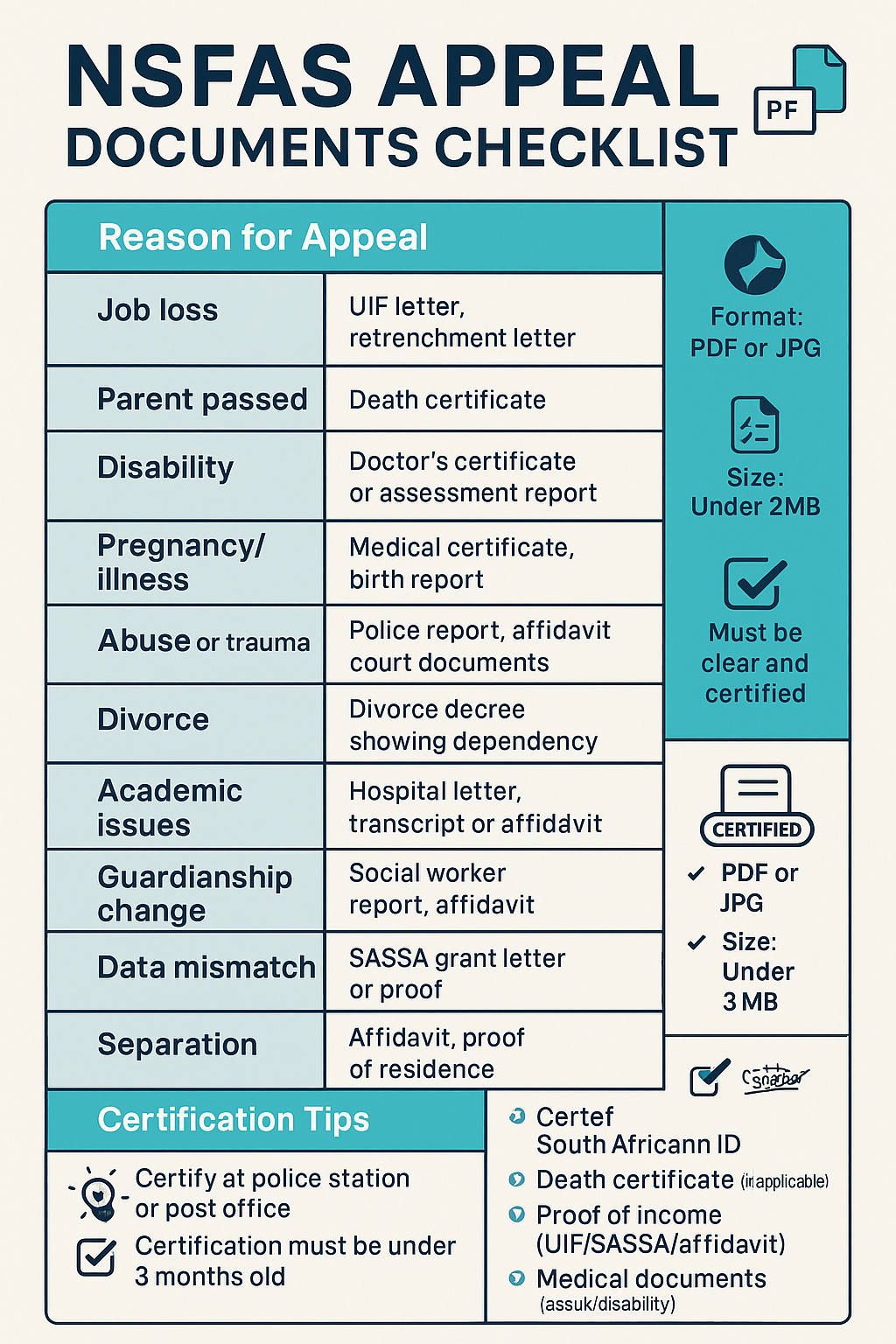
NSFAS Appeal Documents Checklist (2026)
Reason for Appeal | Documents Needed |
|---|---|
Job loss or income drop | UIF letter, retrenchment letter, new payslip showing R0 income |
Parent passed away | Death certificate |
Disability | Doctor’s certificate or assessment report |
Pregnancy or illness | Medical certificate, birth report |
Victim of abuse/crime | Police report, court document, or affidavit |
Divorce | Divorce decree showing single-parent dependency |
Academic issues | Medical report, school transcript, hospital admission letter |
- Format: PDF or JPG
- File size: Under 2MB
- Must be certified and clear
NSFAS Appeal Motivation Letter Format
Dear NSFAS Appeals Committee,
I am appealing my funding rejection due to [state reason briefly]. My situation changed because [short explanation].
I’ve attached [mention documents] as proof. Please consider my appeal for review.
Thank you for your time and understanding.
Sincerely,
[Your Full Name]
[ID Number]
Keep it short, clear, and honest
How to Check Your NSFAS Appeal Status
You can track your appeal through your myNSFAS portal:
- Log in to your myNSFAS account
- Go to Track Funding Progress
- Click the Appeals tab
- Review your status:
- Pending – Appeal submitted but not reviewed
- Under Review – NSFAS is processing your appeal
- Approved – Appeal accepted; watch for payment
- Rejected – Appeal unsuccessful
- Query Closed – NSFAS has responded, and no further changes will occur
Also watch for email or SMS alerts from NSFAS. if you face any problem while accessing portal you must read it.
How Long Does NSFAS Take to Respond to Appeals?
- Normal processing time: 15 to 30 working days
- Delays may occur during busy periods (e.g., Jan–Feb)
If approved
- Sign your NSFAS Bursary Agreement
- Confirm your institution registration
- Upload/update banking details
NSFAS Appeal Approved, But No Funding Yet?
You may still experience delays after your appeal is approved. Common reasons:
- Your college hasn’t confirmed your registration
- You haven’t uploaded your banking details
- You haven’t signed your bursary agreement (NBA)
How to Fix It
- Call or visit your school’s financial aid office
- Log in to your portal and upload or update banking info
- Sign the NBA agreement electronically on the portal
Real Student Case Study
“My appeal was rejected the first time because I used a blurry payslip. I resubmitted the appeal within 7 days with clearer documents and a better motivation letter. Two weeks later, I was provisionally funded and started receiving my allowance the next month.”
— Nthabiseng, University of Johannesbur
Common NSFAS Appeal Mistakes (Avoid These!)
Mistake | Fix |
|---|---|
Uploading blurry or expired documents | Scan or photograph clearly certified copies |
Missing the 30-day deadline | Set calendar reminders to act quickly |
Writing a vague or emotional motivation | Stick to facts and back them with documents |
Not checking portal after submission | Check your status weekly |
Forgetting to upload NBA | Sign it under the “Agreements” tab in your portal |
Final Tips & Action Steps
- Check your portal daily for status changes
- Prepare documents in advance
- Write a short, honest motivation letter
- Submit the appeal within 30 days
- Follow up with NSFAS and your school
- Sign agreement & update banking details after approval
Being rejected is tough — but you’re not out of options. If you present a valid case with real proof, you still have a strong chance to get NSFAS funding in 2026.