NSFAS Application Rejection: What to Do Next (2026 Guide)
Did your NSFAS application come back as “Unsuccessful” or “Rejected”? Don’t worry — it’s not the end of your journey. Many students face rejections for reasons that can be corrected or appealed. This guide will help you understand why NSFAS may have declined your application and what steps you can take next, including appeals, reapplications, and alternative funding options.

Why Was My NSFAS Application Rejected?
NSFAS rejections are usually due to technical, academic, or financial eligibility issues. Here are the most common reasons:
Reason for Rejection | Explanation |
|---|---|
Income too high | Your combined family income exceeds R350,000 (or R600,000 for students with disabilities) |
Missing or incorrect documents | You failed to upload your ID, proof of income, or other required files correctly |
Academic failure | You didn’t meet the required pass rate or exceeded the N+2/N+3 rule |
Incorrect personal data | Your ID info doesn’t match with Home Affairs or your institution’s data |
Duplicate bursary funding | You’re registered for multiple funding programs, which NSFAS does not allow |
Late application | Your submission came after the closing deadline or was for a course not funded by NSFAS |
You can check your rejection reason by logging into your myNSFAS portal and clicking on Track Funding Progress.
What to Do Immediately After NSFAS Rejection
Don’t panic. Rejection is not final. Start by:
- Logging into your myNSFAS portal and checking the specific reason listed.
- Taking a screenshot for your records.
- Collecting the documents needed for appeal.
- Marking your appeal deadline (within 30 days) on a calendar.
- Contacting your institution’s financial aid office for advice.
Understanding the NSFAS Appeal Process
If you believe your rejection was incorrect or unfair, you may qualify to appeal. The NSFAS appeal process allows students to submit documents and a motivation to request a review of their rejection.
Appeal Deadline
You have 30 calendar days from the date of receiving your rejection to appeal via the myNSFAS portal.
How Long NSFAS Appeals Take in 2026
The average NSFAS appeal processing time is:
Phase | Time Frame |
|---|---|
Initial submission review | 3–7 working days |
Full appeal processing | 20–30 working days |
Post-approval payment | 4–6 weeks after approval |
⚠️ Appeals submitted in January–February may experience delays due to high volume.
NSFAS N+2 Rule Explained (And Why It Matters for Rejections)
The N+2 rule means NSFAS will fund you for the minimum duration of your qualification (N) plus 2 additional years for academic failure.
Example:
- 3-year degree = max 5 years of NSFAS funding
- 4-year degree = max 6 years of funding
If you exceed this, NSFAS automatically rejects your application unless you provide valid documentation explaining your delay (e.g., illness, pregnancy, trauma).
Who Can Appeal (And Who Cannot)
You CAN Appeal If
- You can now provide missing documents (e.g., updated proof of income)
- You faced academic difficulty due to illness, disability, or personal hardship
- Your family income changed after application (e.g., job loss, death in the family)
You CANNOT Appeal If
- Your household income is permanently over the threshold with no change
- You applied after the deadline
- You exceeded the N+2 rule without special circumstances
- You’re registered for a course NSFAS does not fund
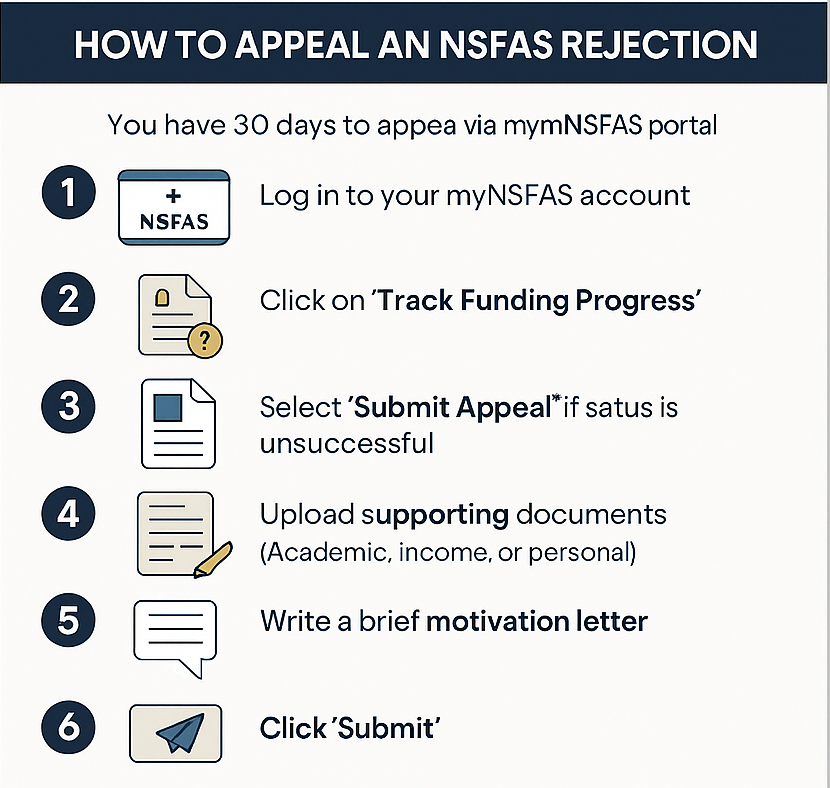
Step-by-Step: How to Submit a Successful NSFAS Appeal
- Log in to your myNSFAS account at www.nsfas.org.za
- Click on Track Funding Progress
- If rejected, select the “Submit Appeal” tab
- Choose your reason for appeal from the drop-down menu
- Upload relevant supporting documents:
- Payslips or UIF letters
- Academic records or medical certificates
- Death certificates or affidavits
- Write a brief motivation letter (max 1,000 characters)
- Click Submit
You’ll receive an email or SMS confirmation after submission.
Student Story – Sipho (UWC)
“My NSFAS was rejected due to an ‘Income too high’ error, but my father had recently passed away. I submitted a death certificate and affidavit. Within 3 weeks, my appeal was approved. If your circumstances change, appeal quickly and with proof!”
How to Check NSFAS Appeal Status (2026)
You can track your appeal through multiple channels:
Via myNSFAS Portal
- Login at www.nsfas.org.za
- Click Track Funding Progress
- Go to the Appeals tab
- Status will show:
Pending,Under Review,Approved,Rejected, orQuery Closed
Via USSD
- Dial
*120*67327# - Select “Appeal Status”
Via WhatsApp
- Message
Hito+27 78 519 8006 - Follow prompts to check status
Check your status at least twice per week during the 30-day processing period.
Sample NSFAS Appeal Motivation Letter
Dear NSFAS Team,
I am appealing my application rejection due to [e.g., my father losing his job in January 2026]. This event has drastically changed my family’s financial situation.
I have attached a retrenchment letter and an affidavit as proof. I respectfully request that you reconsider my application based on this updated information.
Thank you,
[Your Full Name], [ID Number]
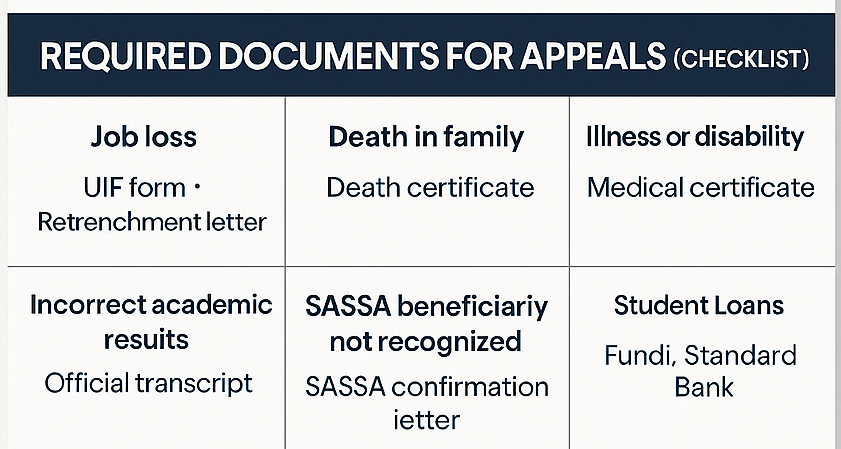
Required Documents for Appeals (Checklist)
Reason | Documents Needed |
|---|---|
Job loss | UIF form, Retrenchment letter |
Death in family | Death certificate, Affidavit |
Illness or disability | Medical certificate or doctor’s note |
Incorrect academic results | Official transcript or institutional letter |
SASSA beneficiary not recognized | SASSA confirmation letter or screenshot |
All documents should be certified, clear, and under 2MB, in PDF or JPG format.
What Happens After You Appeal?
NSFAS usually takes 20–30 working days to review your appeal
- Your portal will show updates like:
- Pending
- Under Review
- Approved
- Rejected
- If successful, your status changes to Provisionally Funded and payment is scheduled after registration
Some appeals may take longer during peak periods (e.g., Jan–Feb).
If Your Appeal Is Rejected
Don’t give up. Here are other funding options you can explore:
1. University Financial Aid
- Visit your institution’s financial aid office
- Ask about emergency grants, food packages, or academic bursaries
2. Private Bursaries and Scholarships
Apply for programs like
- Funza Lushaka (for education students)
- Provincial Government Bursaries
- Sasol, Vodacom, and Allan Gray bursaries
3. Student Loans & Alternatives
Consider loan options from
- Fundi
- Standard Bank Student Loans
- Varsity Wise
Reapply next year once your documents and situation are fully sorted.
Can You Reapply to NSFAS After Rejection?
Yes, you can reapply in the next application cycle even if your appeal fails. But:
- Fix the issue that caused rejection (e.g., correct documents, updated income info)
- Make sure you’re still within the N+2 rule
- Apply early — late submissions are often rejected again
NSFAS opens new applications around September–November for the next academic year.
Real Case Example: How Naledi Won Her NSFAS Appeal
“I was rejected because of ‘incomplete documents’, even though I uploaded everything. I contacted NSFAS, and they told me one file was blurry. I re-uploaded clear versions and added a letter from my school. Three weeks later, my appeal was approved.”
— Naledi M., University of Johannesburg
Lesson: Always upload clear, certified documents and follow up quickly.
Tips to Avoid NSFAS Rejection in the Future
- Apply early (weeks before the deadline)
- Upload certified and readable documents
- Double-check your personal details match Home Affairs
- Avoid using blurry or expired paperwork
- Keep records of everything you submit
- Stay informed by checking your portal weekly
Alternative Funding If NSFAS Appeal Fails
Don’t give up — explore:
University Bursaries
- Emergency aid, hardship grants, food packages
- Ask your institution’s Financial Aid Office
Private & NGO Bursaries
- Allan Gray Orbis Foundation
- Funza Lushaka (Teaching)
- Vodacom Bursary
- Department of Health bursaries (for medical studies)
Student Loans (Last Resort)
- Fundi
- Standard Bank student loans
- Nedbank student assistance
You can even crowdfund on platforms like BackaBuddy if you’re in urgent need.
Final Thoughts: Stay Focused & Take Action
Being rejected by NSFAS can be disappointing, but it doesn’t mean the end of your studies. Many students succeed on appeal or through alternative funding. Act fast, be honest, and always back your appeal with the right documents.
If you’re unable to appeal, use this time to improve your academic results, prepare better documents, or explore other bursary programs. Stay proactive — your educational journey is still in your hands.